




Ford’s F-150 Lightning and the National Forest Service are Promoting EVs
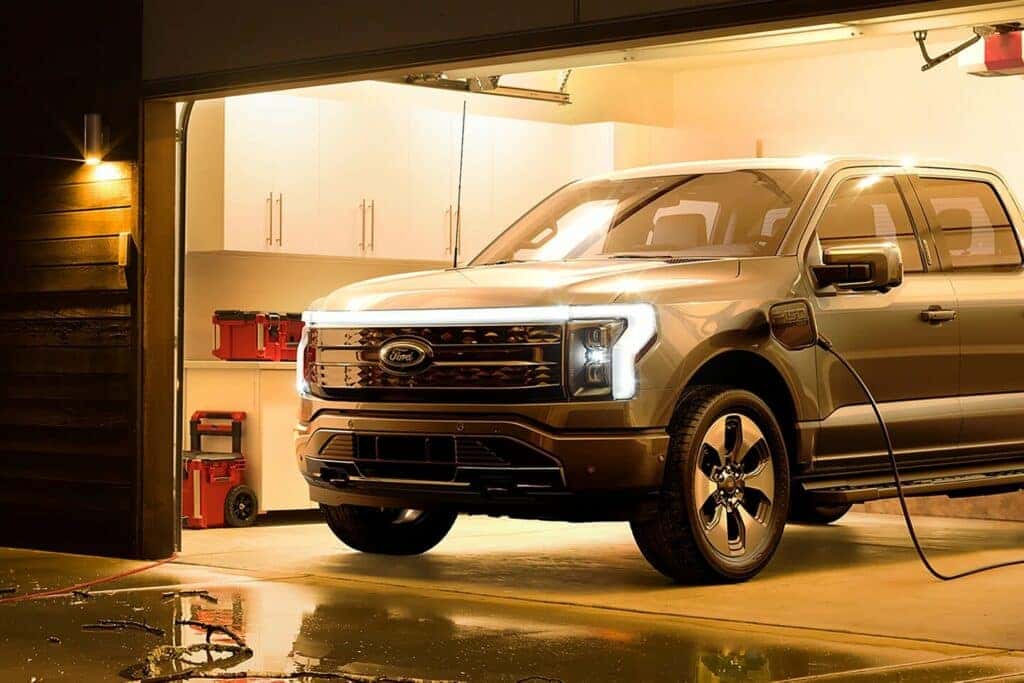
Photo Source: Ford
The United States Forest Service has a long legacy of working with Ford to achieve its goals. In the early 20th century, the U.S. Forest Service began using motor vehicles with Ford Model Ts. In an age when eco-friendly cars are quickly making headway, the agency has yet again looked to Ford. Nowadays, the U.S. Forest Service is searching for technological modernization within the realm of an electric vehicle pilot program. Specifically, the agency will depend on three Ford F-150 Lightning pickup trucks over twelve months to decide their efficacy compared to internal combustion engine vehicles. During the year-long test, any problems or mishaps the vehicles may encounter will be categorized and dealt with to reach a goal for 2027, which is for all light-duty vehicles to be zero-emission vehicles. “It’s a quasi-experimental approach to systematically evaluate use (frequency, quality, safety, experience) of EVs relative to Internal combustion vehicle use over the study period,” explained a Forest Service spokesman.
Range Poses No Barrier
The pickup trucks will be studied in an area that contains twenty states, the Eastern Region of the United States. The main focus will revolve around the Allegheny National Forest, Huron-Manistee National Forest, and White Mountain National Forest. As it stands, the Eastern Region has 1,489 vehicles at its disposal. There are thirteen hybrid cars and seven more that function using compressed natural gas. On a nationwide scope, twenty-four hybrids can be found in the Forest Service.
Each Ford F-150 Lightning has an approximate 230 miles of range. Given the distance each vehicle can reach, properly taking stock of the previously mentioned locations should be feasible. Jasen Turnbull, F-150 Lightning brand marketing manager, claims that the vehicle is prepared with an Intelligent Range system. Such a system can determine the range needed to finish a trip by considering factors like cargo, temperature, route, trailer load, and terrain. The determination of the range could identify how many more charging stations are necessary, other than the thirty-two currently available nationwide. In fact, one of the stations in Oregon is even solar-powered.
Success in the Forest Service
Ultimately, the electric vehicles will help the Forest Service ascertain what is imperative for the Ford F-150 Lightning to perform adequately as part of the fleet and how to incorporate it successfully as soon as electric vehicles join the fleet in much greater numbers. The current price tag for these automobiles is $53,769 MSRP (Plus destination fee). Nonetheless, changes have not been made besides adding the Forest Service logo to the doors.
It is unlikely that these pickup trucks will be the only battery-electric vehicles that form part of the United States Forest Service’s fleet, especially in the face of President Biden’s executive order that stipulates the entire federal government fleet to go zero emissions. That is an overall number of over 600,000 vehicles. With an abundance of battery-electric vehicles making their way into the market, more than just F-150 Lightning trucks will likely be used in local and national forests. The change is already occurring, as the Forest Service’s light-duty vehicles will eventually evolve their heavier trucks to zero emissions in 2035.
The Future Looks Bright
The Ford F-150 Lightning is already starting to become a fundamental part of the stomping grounds for electric vehicles. We encourage you to come to Sunrise Ford and decide if this is the automobile for you. We invite you to look at our current inventory and ask for more information if necessary. Our sales team is passionate and committed to making your shopping experience a pleasant and informative one.